Friday, 10 February 2012

Cruze Wagon Estate to be unveiled at Geneva Motor Show

General Motors will unveil the Station Wagon version of the Cruze at the 82nd Geneva Motor Show.  The Wagon version gets a maximum of 1500 litres of boot space. 


The engine on the Wagon Estate version will be the 1.7-litre VCDi that produces 130bhp of power with Start-Stop as a standard fitment. At 4,678mm, the Station Wagon is longer than the hatchback (4,510 mm) and saloon (4,597 mm) models. Load space ranges from 500 litres up to the window line in the rear to nearly 1,500 litres up to the roof top with the rear seats folded down.

Volkswagen wins the AIMIA Loyalty Award

Volkswagen has won the AIMIA Loyalty Award for outstanding Customer & Brand Loyalty in the automobile sector at the 5th Loyalty Awards 2012.  The award is one of most coveted award for Customer & Brand Loyalty in the automobile sector. Volkswagen represented the award in the four wheeler category and was pitted against country’s leading automobile manufacturers.

Volkswagen introduced customer focused marketing initiatives like Prospect Dialogue Program (PDP) and Customer Dialogue Program (CDP) to increase customer engagement to reiterate brand commitment. Prospect Dialogue Program (PDP) included Lead processing activity - a 10-minute call back facility to customers in an effort to reach out to their needs. 

The Loyalty awards by AIMIA are the outcome of a combination of consumer research undertaken across 5 major cities of India aided by nominations received from various organizations.

Thursday, 9 February 2012

370Z for 2012 unveiled

Nissan has unveiled the 2012 version of its sports coupe 370Z.  The 370Z first came to the world in October 1969 as ‘Nissan Fairlady Z’.  It was followed by many versions i.e. the 240Z, the 260Z, the 280Z, the 280ZX, the 300ZX, the 350Z and now the 370Z.  This car produces 332 bhp from its 3.7 Liter, V6 engine with a 6-speed manual or a 7-speed automatic transmission gearbox.


New features on the Z facelift are the vertical LED daytime running lights, rear reflectors, 19-inch aluminum-alloy wheels, and Euro-tuned shock absorbers.  It will be now available in two new colours - Magma Red and Midnight Blue. Also, the brake callipers get a red finish. The coupe will be available as a convertible and in the official in-house tuner masked Nismo putting out impressive 350PS and 276Nm of torque with a power to weight ratio of 206 bhp/tonne.


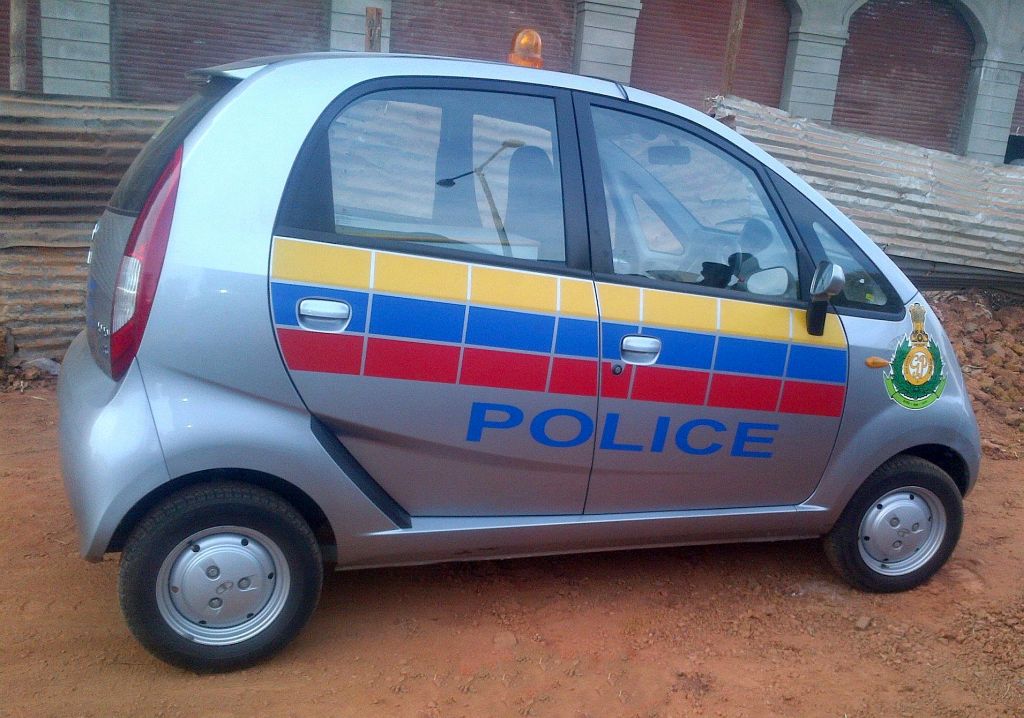
Goa Police in Nano

The Goa Police has become the second police force after Mumbai Police to adopt Nano as its vehicle.  Nano with its small dimensions, will be helpful in doing the city duty where roads are not so wide and traffic density is quite high.  Moreover, Nano will be protecting the cops from adverse weather conditions i.e rain and summer and reducing the fatigue due to foot patrolling.


Wednesday, 8 February 2012

Xylo 2012 launched

Mahindra has launched the facelifted version of its MPV - Xylo today with a price starting from Rs. 7.37 lakh (ex-showroom at Delhi).  The first version was launched in January 2009.  The front of new Xylo is more like that of XUV 5OO with a floating roof and crease lines making it more contemporary.


The new Xylo will now be available with the new E9 version with mHawk engine.  This engine is present in Scorpio. This mHawk engine is a 2.2-litre common rail diesel producing 120bhp of power and a maximum torque of 280Nm. The mEagle and the mDI CRDe engine options will still be available on the lower versions of the Xylo. The E9 also gets Italian Leather wrapped seats and gear-knob and cruise control.


To reduce the body roll of the Xylo, Mahindra has introduced the E.S.T. (Extra Stability Technology), which improves the stability of the Xylo. The suspension of all the variants have been tweaked. The digital display system has become sleeker than before.

The price for the highest version i.e. E9 is Rs.10.25 lakh, ex-showroom at Delhi.

Discounts continue even in February

The economic slowdown and high petrol prices have affected car manufacturers badly.  The discounts which start before Diwali festival season in October-November and peak in December with the year end, are still continuing although it is February now.  Discounts are generally for petrol models only.  Diesel versions, on the other hand, have long waiting lists.  Only a few petrol cars like Jazz, Brio from Honda and Verna from Hyundai command waiting period. 


Tuesday, 7 February 2012

25000 plus bookings for XUV 5OO in second phase

Mahindra has got more than 25000 bookings for its super successful SUV XUV 5OO in the second phase of bookings.  This phase was opened on 25th January this year for ten days.  To make the delivery process transparent and to ensure that waiting time is minimum, Mahindra will deliver the vehicles to the winners of draw of lots that will be undertaken in February among these 25000 plus candidates for 7200 vehicles.  

M&M in race for Saab

Mahindra & Mahindra (M&M), the Indian automaker, has signed a confidentiality agreement with the Swedish Automaker Saab.  M&M is one of the four companies showing interest in buying Saab.  Reports say that M&M is finalizing its bid with the help of its banker Kotak Mahindra.

Sources said that the M&M team is at Saab’s Trollhattan factory in Sweden to work out the deal. Sources also said the top brass of M&M auto and its M&A team will meet later this week and take a final call on the structure of the bid.

Senior officials of M&M refused to comment.
     
The biggest hurdle in the revival of Saab is regarding technology, which the former owner General Motors (GM) has refused to part with. Sources said GM has made it clear that it will not give intellectual property rights (IPRs) to any buyer for the 9-4x and 9-5 models, leading to the failure of an earlier bid by Chinese automaker Zhejiang Youngman Lotus Automobile. Since then, Youngman has put in a revised offer of 3 billion crowns ($446 million) for Saab, according to news reports.

Criminal case against MD, Volkswagen and others

A court in Delhi has instructed the Police to lodge a case on a complaint against Managing Director of Volkswagen, directors of its authorised car dealer and a official of transport department on the issue of illegal charges levied on buyers.


The complaint filed by advocate Rajiv Ranjan Raj alleged levying of illegal charges by car dealers and sought lodging of FIR for cheating, criminal conspiracy, criminal breach of trust and for offences under Prevention of Corruption Act.

He made car dealer Bhasin Motors, its four directors, MD of Volkswagen India Pvt Ltd and a Motor Licensing Officer of Delhi transport department as party in the case.  He said Bhasin Motors charged him Rs 3,911 as handling and number plate charges apart from VAT March last year.


Mark Gorton, the Anti-automobile Crusader

Times of India has reported that New York entrepreneur Mark Gorton, an anti-automobile crusader, is currently in India to spread the message about just how wrong an automobilebased transport system is for the world. 

“India has the historical advantage of being able to see the damage that automobiles have done to cities in Europe, America and China. It can decide not to commit the same mistake,’’ he said. 

Gorton firmly believes in what Enrique Penalosa, a former mayor of Bogota, once said — you can have a city that is friendly to cars or friendly to people. You cannot have both.  Bumper-to-bumper traffic on urban streets is no coincidence and is a reflection of poor planning, said Gorton.  He believes in the need for a government policy, which works towards automobile suppression that includes punitive taxes on cars. “In Shanghai and Singapore, you need a permit to own a car. 

“In Tokyo, you first need proof of parking before you can buy a car,’’ the anti-automobile crusader added. 


Delhi, for instance, is trying to do the physically impossible by filling the streets with automobiles though there’s no space to fit them, he said.  On the other hand, he points to cycling tracks in cities like Ahmedabad. 

“Much of Europe is now looking at designing roads for bicycles. It’s only when streets have designated cycle tracks and are safe for cyclists that people will want to ride bicycles,’’ he said. 

His grouse against automobiles goes beyond the obvious concerns over pollution and congestion. He is concerned with the intangible fallout of living on a street that is crowded by cars and has little space to walk. 
“When there were fewer cars on New York streets, the city was safer for children, who could cross over, walk to school or run to a park.  A child’s world was, say, a kilometre in diametre. It has now been reduced to a few metre in front of the house,’’ Gorton said. 

He said this may well be a cause for childhood obesity, as children have no place to walk on the streets. “You now need an adult to accompany a child from one place to another,’’ he said. 
He points to studies which show that on an average people, who live on streets having heavy vehicular traffic have fewer friends in the neighbourhood than those who dwell on quieter streets.  Gorton is armed with data to prove cars are among the most inefficient means of transport. 

“Before New York moved to a transport system dependent on cars, the system was rail-based. Today, there are 370,000 fewer people entering New York’s Central Business District each weekday than there were in 1948,’’ he said.

Monday, 6 February 2012

Hyundai i-flow concept car at Plastindia 2012

Press release from BASF regarding i-flow, concept car based on collaboraion between Hyundai and BASF

Delhi, India – February 1, 2012 – BASF, the world’s leading chemical company, invites visitors of Plastindia 2012 to be amongst the first in India to view the i-flow, a one-of-a-kind concept car based on a unique collaboration between BASF and Hyundai Motor Group. The breathtaking design of the i-flow is coupled with a wide range of innovative features, which are beneficial to the environment as well as eye-opening to many carmaker and car lovers. The i-flow will be displayed at the BASF booth during Plastindia 2012 from February 2 – 3, 2012.

BASF's contributions to the i-flow allow greater fuel efficiency, reduced environmental impact, freedom of design as well as greater comfort and safety. As a result, the concept car offers important new approaches to sustainable mobility. In view of these energy-efficient contributions in the i-flow project, BASF was granted the ÖkoGlobe award, an international environmental award in the area of mobility, sponsored by the University of Duisburg-Essen and spearheaded by automotive expert Prof. Ferdinand Dudenhöffer.


A concept for the seat frame of the i-flow provides an example for how lightweight construction materials can help conserve resources. It features Ultramid® Balance, a polyamide that consists to 60 percent of renewable raw materials, as well as other thermoplastics and energy-absorbing foams. The joint goal was to save as much weight as possible by using plastic components.


Luquafleece® is a moisture-absorbing material: When incorporated into seats it ensures that drivers and their passengers enjoy a pleasant seating climate even at the height of summer. Elastollan®, a thermo-plastic polyurethane elastomer, can be used for high-quality surfaces. It is abrasion-proof and can be produced in a wide range of both light and dark interior colors. The BASF polyurethanes material Elastoskin® is used for the dashboard and for interior automotive parts. It is characterized by an exceptional optic and haptics, combined with a pleasant soft touch. At the same time it provides the highest freedom in design for colors, textures and geometries.

The i-flow's energy concept provides an impressive example of high tech. The modern diesel engine is encapsulated with a rigid foam polyurethane insulation system that protects both the engine and the environment. On short trips and in city traffic especially, engines are slow to reach the optimum operating temperature or cool down quickly. The thermal engine insulation lessens this effect, reducing both emissions and fuel consumption. In addition, a harvesting system using the thermoelectric effect converts heat from the exhaust gases into electrical energy that helps power auxiliary systems. This results in significant fuel savings.

A new catalyst from BASF combines four technologies to cut emissions in just two components. As a result, it is possible to satisfy increasingly stringent emission standards for automobiles at a relatively favorable cost. At the same time, the new solution saves both weight and space.

Passive heat management can be used to reduce energy consumption even further. For example, a wide range of infrared-transparent and infrared-reflecting pigments in the car interior result in cooler plastic surfaces for the dashboard, seat and center console. Pigments from BASF's Sicotan®, Sicopal® and Lumogen® ranges provide very dark or black surfaces that remain distinctly cooler when exposed to sunlight. The result: greater comfort and less energy for air conditioning.

Modern vehicle interiors aim for maximum comfort. The BASF innovation Steron® is a soft-touch coating technology. Various textures even with a high complexity can be designed, varying from soft velvet to a smooth silky touch, always keeping a natural feel.

A literally brilliant effect is provided by a new mirror-like paint from BASF Coatings: The Liquid Metal basecoat makes the i-flow look as though it is chrome-plated rather than painted. In addition, the innovative iGloss clearcoat makes the paint surface both scratch-resistant and weather-resistant.

CB 300R patented in India

It seems the 300 - 400 cc segment in India is getting hotter and attractive. Just after news of Kawasaki developing a naked version of Nin...